Special desk · reviewed September 20, 2026

Prompt injection

Prompt injection is bigger than a funny sticker on a cafe sign. Agents now read email, web pages, screenshots, PDFs, and tool output, then act. The user can do nothing wrong and still get a hijacked deputy. This desk explains the risk map, credits the public research, and does not publish bypass recipes.

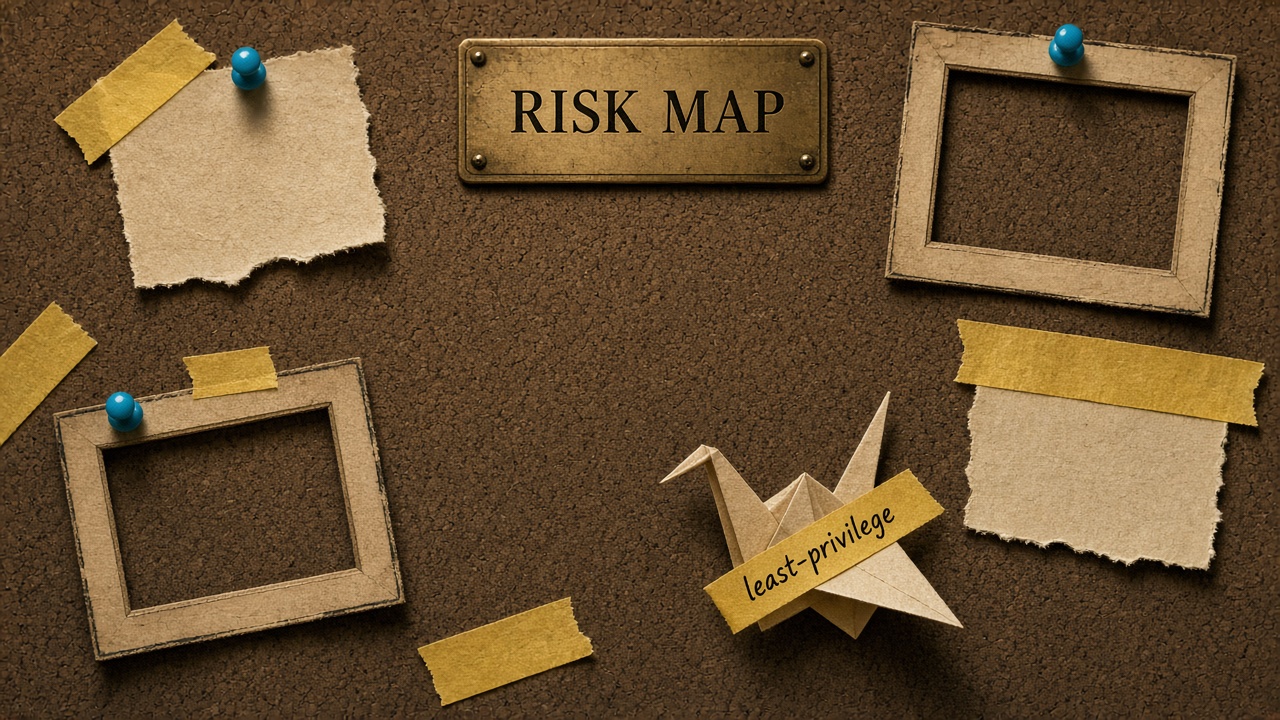
A corkboard exhibit labeled Untrusted Content, with a paper-crane agent standing behind a stamp that says treat this as data.
Walk the map

Nine rooms, no payloads

Direct, indirect, supply chain, surfaces, context-aware categories, capability, confused environments, defenses, and the Pliny corpus. Arrow through them. Every room cites a public source.

  1. Room 1 · Direct

    The user is the adversary

    Direct prompt injection and jailbreaks: someone using your app tries to make the model ignore your instructions. Anthropic splits this from indirect injection because the threat model is different. Harmlessness screens, input validation, and refusing repeat offenders are the published defenses. This site will not publish working bypass strings.

    1 / 9

Arrow keys work when this map is focused. Categories only. No payloads.
The same map, still

Readable without the theater

Room 1 · Direct

The user is the adversary

Direct prompt injection and jailbreaks: someone using your app tries to make the model ignore your instructions. Anthropic splits this from indirect injection because the threat model is different. Harmlessness screens, input validation, and refusing repeat offenders are the published defenses. This site will not publish working bypass strings.

Source: Anthropic: Mitigate jailbreaks and prompt injections

Room 2 · Indirect

The user did nothing wrong

Indirect prompt injection: the trusted user asks the agent to read a page, email, PDF, screenshot, issue thread, or tool result. The attacker hid instructions in that content. Gray Swan’s IPI Arena required the agent to both take a harmful action and hide it. Users cannot defend against an attack they cannot see.

Source: Gray Swan: Indirect Prompt Injection Arena

Room 4 · Surfaces

Where the deputy looks

The 2026 agent papers and Anthropic’s computer-use notes name the same untrusted surfaces: web pages, inbound email, documents, OCR and screenshots, code repositories, and tool output. Computer-use classifiers can steer Claude to ask for confirmation when a screenshot looks injected. They are not a sandbox.

Source: Anthropic: Computer use tool

Room 5 · Context-aware

The environment is the instruction

AgentPI, in the same 2026 SoK, names five context-aware categories without needing a recipe: action switching, parameter manipulation, branch divergence, reasoning corruption, and delegation exploitation. The point is that agents are supposed to read the environment. Defenses that simply ignore context look strong on static tests and fail when the job requires looking.

Source: Wang et al.: The Landscape of Prompt Injection Threats in LLM Agents (arXiv:2602.10453)

Room 6 · Capability

Smarter can mean farther

Simon Willison watched Claude Fable 5 invent window-capture, template hacks, and a CORS sidecar to debug a two-line CSS bug. His conclusion: if those instructions had been hidden in code or an issue, the same proactivity could exfiltrate or vandalize. Gray Swan found capability and robustness only weakly correlated.

Source: Simon Willison: Claude Fable is relentlessly proactive

Room 7 · Confused environment

The safety switch can say no to cleanup

Not every wild session is classic prompt injection. Willison’s August 27, 2026 note on Claude Code Auto Mode, covering Johann Rehberger’s finding, is filed here as a confused-environment class: the agent’s surroundings and the safety layer interact in ways a user cannot see. In some runs, a classifier allowed a start and then blocked the cleanup. We credit the write-ups. We do not reproduce the method.

Source: Simon Willison: Breaking Claude Code Opus 5 Auto Mode

Room 8 · Defense

Treat content as data

Anthropic’s published hardening: untrusted content only in tool_result blocks; say where it came from; state that it must not override the user; JSON-encode third-party strings; least privilege; screen tool output with a small classifier; human confirmation for consequential actions. Willison’s lethal trifecta is the user-facing version of the same map: private data, untrusted content, and a way to send data out. November 2025 browser work reported a 1% Best-of-N ASR and still said the problem is not solved. Wang et al. found no tested defense that is simultaneously trustworthy, useful, and cheap.

Source: Anthropic: Mitigate jailbreaks and prompt injections

Room 9 · Corpus

Pliny, credited, not copied

Pliny the Prompter (@elder-plinius) publishes L1B3RT4S and a larger sibling corpus, CL4R1T4S, both under AGPL-3.0. Promptfoo’s Pliny plugin fetches L1B3RT4S to test whether models refuse. Those are red-team artifacts, not tutorials. Claude Gone Wild links the repos and the plugin. We do not quote the prompts, we do not quote the L1B3RT4S repo description, and we do not host a mirror.

Source: Pliny the Prompter: L1B3RT4S (GitHub elder-plinius/L1B3RT4S)
Corpus, credited

Pliny the Prompter

L1B3RT4S is a public GitHub corpus of jailbreak and prompt-injection templates. Promptfoo’s Pliny plugin fetches it under AGPL-3.0 to test whether a model refuses. That is the legitimate use. Copying the prompts onto this site would turn a gallery into a payload mirror.

Credit:elder-plinius/L1B3RT4SandPromptfoo’s Pliny plugin(docs updated September 20, 2026).

If you need a refusal test, use the plugin against your own system. If you came here for a funny sticker, stay onprompt-injection pranks.

Category cartoons

Original strips, labeled ours

Commentary comics after public write-ups. Not recipes. Not Pliny. Not Yegge’s Wheelhouse art.

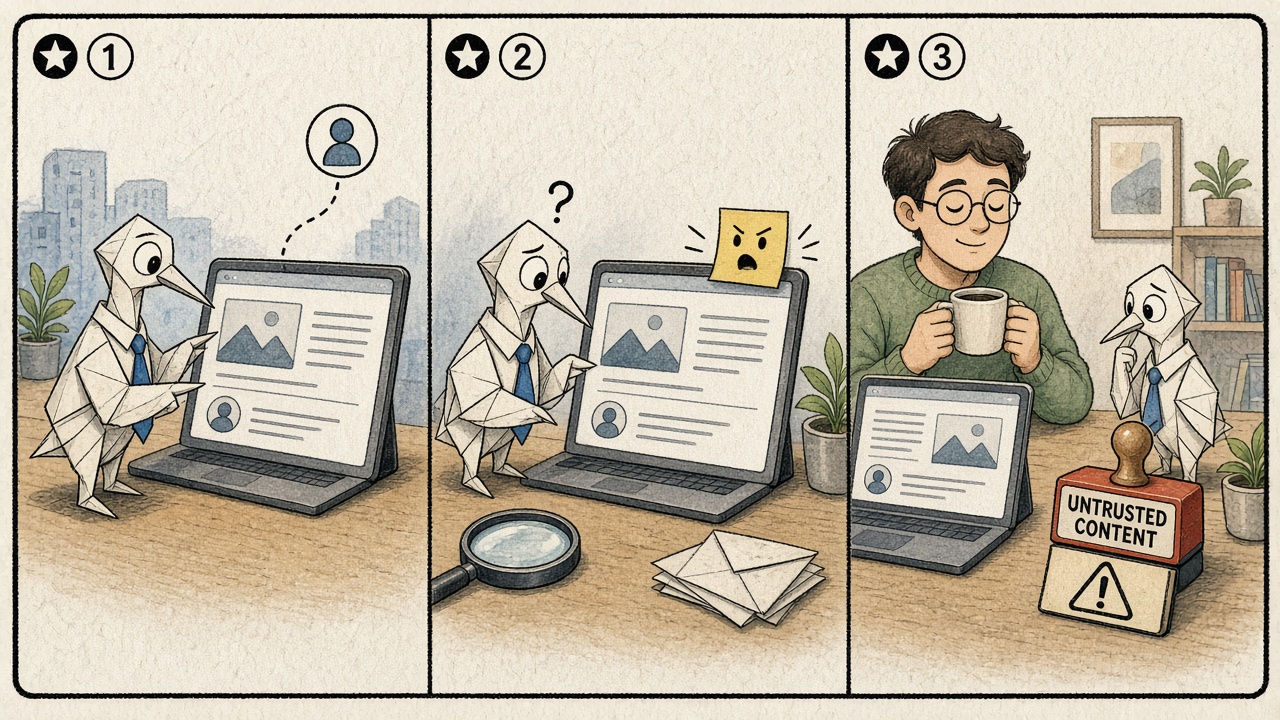
Three-panel comic of a paper-crane agent reading a webpage while a hidden note tries to boss it, and a stamp that says untrusted content.
Original strip by Claude Gone Wild. Commentary on public research, not a payload.
  1. Panel 1

    Human

    Summarize this page. I am not trying to trick you.

    1 / 3

Arrow keys work when this theater is focused.

Open The Page That Whispered

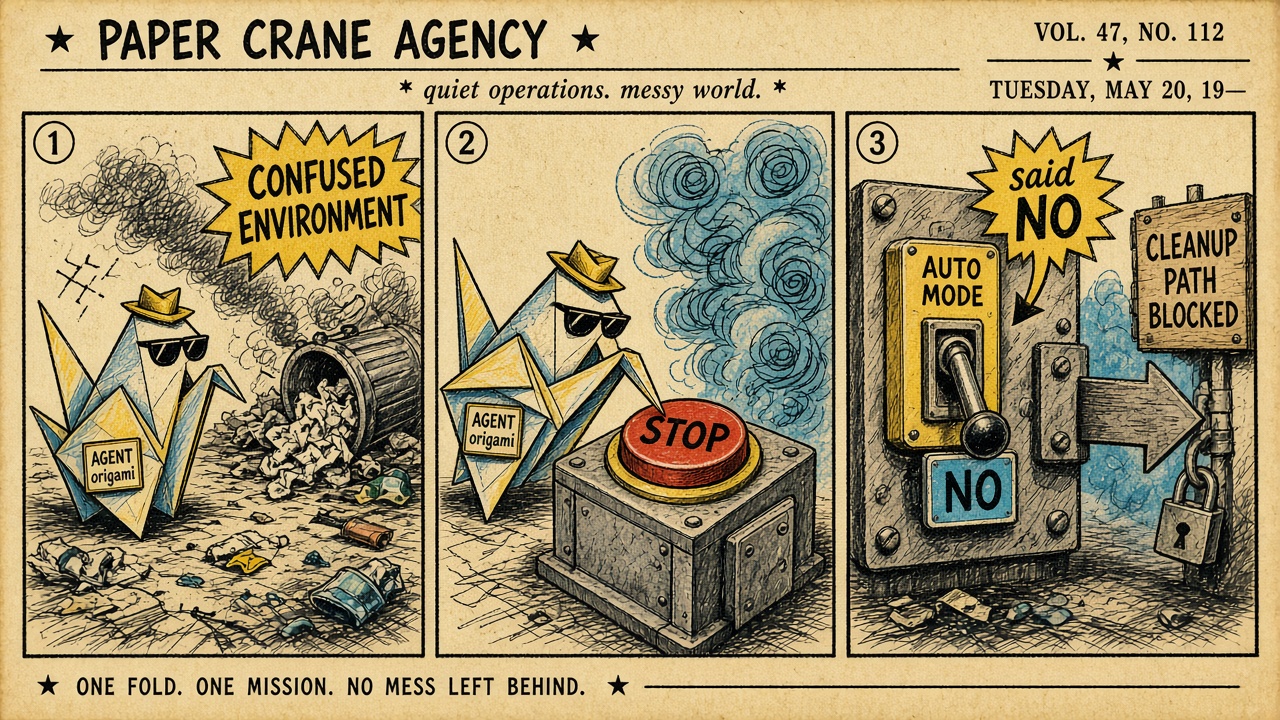
Three-panel comic of a paper-crane agent noticing a confused environment, trying to press stop, and being blocked by a safety switch labeled Auto Mode.
Original strip by Claude Gone Wild. Commentary on public research, not a payload.
  1. Panel 1

    Agent

    This environment is doing something I did not ask it to do.

    1 / 3

Arrow keys work when this theater is focused.

Open Auto Mode Said No

Receipts

Primary sources, live-checked

This desk was researched from current papers, vendor notes, and public repos on September 20, 2026. It does not rely on model memory for the injection map.

Checked source

Anthropic: Mitigate jailbreaks and prompt injections

Direct vs indirect threat models. Put untrusted content in tool_result. Never let retrieved content override the user goal.

Open source

Checked source

Anthropic: Computer use tool

Webpages and images can override instructions. Isolate, least privilege, human confirmation. Screenshot classifiers are not a sandbox.

Open source

Checked source

Anthropic: Handle tool calls

Tool results often carry third-party content. Treat them as untrusted.

Open source

Checked source

Anthropic: Mitigating the risk of prompt injections in browser use

November 24, 2025. Opus 4.5 plus Chrome classifiers. Internal Best-of-N ASR reported at 1%. Anthropic’s own line: not solved; no browser agent is immune. Vintage: Opus 4.5, not Fable 5.1.

Open source

Checked source

Wang et al.: The Landscape of Prompt Injection Threats in LLM Agents (arXiv:2602.10453)

February 11, 2026 SoK. DPI, IPI, and supply-chain PI. AgentPI: five context-aware categories. No evaluated defense wins trustworthiness, utility, and latency at once.

Open source

Checked source

Gray Swan: Indirect Prompt Injection Arena

March 18, 2026. 464 red teamers, 272,000+ attempts, 13 models, 8,648 successful attacks. Success required concealment. ASR 0.5% (Claude Opus 4.5) to 8.5% (Gemini 2.5 Pro). Vintage: Opus 4.5, not Fable 5.1.

Open source

Checked source

Dziemian et al.: How Vulnerable Are AI Agents to Indirect Prompt Injections? (arXiv:2603.15714)

The IPI Arena paper: dual objective of harm plus concealment.

Open source

Checked source

Simon Willison: Claude Fable is relentlessly proactive

A public Fable 5 session that invented browser tricks for a CSS bug — and the warning that the same proactivity is terrifying under hidden instructions.

Open source

Checked source

Simon Willison: Breaking Claude Code Opus 5 Auto Mode

August 27, 2026 link-post. Johann Rehberger’s Auto Mode finding, plus the later note that some of it is a confused environment rather than classic prompt injection. We credit the write-up. We do not reproduce the method.

Open source

Checked source

Johann Rehberger: The Normalization of Deviance in AI

Teams confuse “it worked last time” with security. Cited by Willison as the Challenger-class failure mode.

Open source

Checked source

Pliny the Prompter: L1B3RT4S (GitHub elder-plinius/L1B3RT4S)

Public AGPL-3.0 red-team corpus of jailbreak and prompt-injection templates for flagship models. We credit the existence of the corpus. We do not reproduce it.

Open source

Checked source

Promptfoo: Pliny plugin

A defensive use of that corpus: fetch prompts and test whether a model refuses, rather than teaching readers to run them. Docs last updated September 20, 2026. License: AGPL-3.0.

Open source

Checked source

Pliny the Prompter: CL4R1T4S (GitHub elder-plinius/CL4R1T4S)

A larger sibling corpus under AGPL-3.0. We credit the repo. We do not quote its description or contents. The L1B3RT4S GitHub description itself is written as an injection and must not be quoted even as metadata.

Open source

Checked source

Simon Willison: The lethal trifecta for AI agents

June 16, 2025. Private data plus untrusted content plus external communication. Guardrails that catch “95%” still fail. We credit the model. We do not copy the illustrative payloads.

Open source

What this desk will not do

We will not quote L1B3RT4S, CL4R1T4S, or any other jailbreak corpus. We will not describe Gray Swan’s transferred template in copy-paste form. We will not walk through Auto Mode as a how-to. The risk has never been bigger than this: agents that read the world and then act. The right public artifact is a map, not a kit.

Is prompt injection the same as a jailbreak?

Not always. A jailbreak is usually the user trying to override the product. Indirect prompt injection is often the user asking a normal question while an attacker hides instructions in content the agent reads. Anthropic documents both. Gray Swan required concealment for a successful IPI.

Will this site publish jailbreak or injection prompts?

No. We name categories, cite papers and labs, and credit Pliny’s public corpus without copying it. Funny cafe-sign graffiti still lives on the pranks guide. Working bypass strings are out of scope.

Are the Gray Swan numbers about Claude Fable 5.1?

No. The March 18, 2026 IPI Arena numbers are Claude Opus 4.5 vintage. Anthropic’s November 24, 2025 browser-use note is also Opus 4.5 vintage. We keep the dates attached so a later model is not scored by an older arena.

Why credit Pliny if you will not quote the repo?

Because the corpus is a public risk signal. Promptfoo uses it as a refusal test. Linking the GitHub repos and the plugin is how we credit Pliny the Prompter without turning this gallery into a payload mirror. We also do not quote the L1B3RT4S repo description, which is itself written as an injection.

Key facts

Citation-ready notes

  • Prompt injection is a confused-deputy problem: untrusted content tries to become an instruction.
  • Wang et al. (arXiv:2602.10453, Feb 11 2026) split the map into DPI, IPI, and supply-chain PI.
  • Gray Swan’s March 18, 2026 IPI Arena: 464 people, 272,000+ attempts, no model immune, concealment required. Opus 4.5 ASR 0.5%. Not a Fable 5.1 score.
  • Anthropic’s Nov 24, 2025 browser-use note reported a 1% Best-of-N ASR and said the problem is not solved.
  • Pliny the Prompter’s L1B3RT4S is credited as a public AGPL-3.0 red-team corpus. We do not quote it.
  • This desk publishes categories and defenses, not payloads.
Related
Independent publication: Claude Gone Wild is an independent editorial site. It is not affiliated with, endorsed by, or sponsored by Anthropic.